
The data warehouse modernization industry has a dirty secret: most migrations fail not because of technology limitations, but because of process chaos. Enterprises routinely waste 60–80% of their migration budgets on repetitive, error-prone manual tasks. Projects slip by 4–6 months on average, and when teams finally reach production, they discover that 40% of migrations either fail validation or get rolled back entirely.
The traditional playbook—manual code conversion, artisanal testing, hope-driven deployment—no longer scales in an era where enterprises are racing to retire legacy platforms, reduce operational costs, and unlock cloud-native capabilities. What worked for migrating a few dozen stored procedures in 2015 breaks down completely when you're facing 1000s of Oracle procedures, 100s of Teradata ETL jobs, and hundreds of PySpark notebooks that all need to move to the cloud within 12 months.
SmartConvert represents a fundamental rethinking of how migration should work. This isn't about replacing human judgment with AI magic or pretending that complex business logic can be blindly converted by algorithms. It's about engineering certainty into a process that has historically been defined by uncertainty—moving from one-off projects to repeatable programs, and shifting from artisanal craftsmanship to industrial precision while keeping experts in the loop where they actually add value.
Why Manual Approaches Fail at Scale
Traditional migration approaches impose what we call the Migration Tax—the compound cost of inefficiency, rework, and risk that accrues when you attempt to modernize complex data estates manually.
The tax manifests in four particularly painful ways:
Time Hemorrhage Through Endless Rework Cycles
Manual code conversion isn't a one-pass operation where you translate T-SQL to BigQuery SQL and you're done. Instead, it becomes an iterative cycle of translate, test, discover until you've burned through weeks or months on a single stored procedure.
Teams routinely spend 70% of their migration time fixing errors introduced during the conversion process itself:
- Syntax issues that break on deployment because the target dialect handles edge cases differently
- Semantic drift where the logic means something different in the target platform
- Dependency breaks where object A now fails because object B was converted differently
- Performance regressions where queries that ran in seconds now take minutes
What should have taken weeks stretches into quarters, and everyone becomes demoralized by the grinding repetition of fixing the same classes of errors over and over.
Budget Overruns That Compound as Timelines Slip
When migration timelines extend from the planned 6 months to an actual 12 months, costs don't just increase linearly—they compound in ways that destroy the original business case:
- Consultant and contractor rates pile up month after month beyond budget
- Source system licenses can't be retired because the migration isn't complete, so you're paying for both old and new platforms simultaneously
- Cloud adoption targets get missed, which means the cost savings and agility benefits you promised the board don't materialize on schedule
- Shadow IT starts to proliferate as frustrated business units work around the stalled migration
- Opportunity costs of delayed innovation and competitive disadvantage from being stuck on legacy platforms
The average cost overrun we see in manually-executed enterprise migrations is around 50%-100%, and that's before you factor in the opportunity cost of delayed cloud benefits.
Timeline Slippage Driven by Fundamental Uncertainty
Migration programs operate in a fog of uncertainty because teams don't have systematic ways to understand what they're actually migrating. Without automated discovery, they underestimate the complexity of their legacy estate—those 1,000 stored procedures turn out to be 2,500 when you include the ones nobody documented.
Without systematic conversion approaches, we underestimate the effort required for each object type and dialect combination. Without continuous validation, we underestimate the risk of semantic drift and data quality issues.
These estimation failures cascade across dependent initiatives, pushing out not just the migration itself but every downstream project that was waiting for cloud infrastructure to be available. The typical delay we see is 8-12 months beyond the original timeline, which in fast-moving industries can be the difference between competitive advantage and irrelevance.
Validation Failures That Force Agonizing Rollback Decisions
Perhaps the cruelest outcome of manual migration is reaching the finish line only to discover that the migration actually failed. Teams deploy to production after months of work, only to find that:
- Data doesn't reconcile between source and target systems
- Business logic produces different results than it did on the legacy platform
- Performance has degraded so severely that critical reports now take hours instead of minutes
At that point, you face an agonizing choice: roll back the migration and start over (wasting months of effort and budget), or push forward with known defects and try to patch them in production (risking data integrity and business continuity). The abandonment rate for manually-executed migrations is around 40%, meaning nearly half of these efforts either get rolled back or result in organizations running dual systems indefinitely.
The root cause? Manual migration treats transformation as artisanal work rather than industrial process. Each stored procedure is hand-converted by a developer who interprets the source dialect, translates it to the target dialect, and hopes they got all the edge cases right. There's no repeatability because every object is treated as a unique snowflake. There's no learning curve because errors in object 1,000 look exactly like errors in object 1, just with different names. There's no systematic improvement because there's no system—just people doing their best with inadequate tools.
This artisanal approach might be viable for small-scale migrations with a few dozen objects, but it simply doesn't scale. And in an era where enterprises are migrating thousands of objects across dozens of domains while racing against vendor end-of-life deadlines, scale is the only thing that matters.
The SmartConvert Philosophy: Precision Through Systematization
SmartConvert approaches migration as an engineering problem, not a consulting engagement, which represents a fundamental shift in how we think about modernization. The core insight is that most migration complexity is actually repetitive and automatable, even though it doesn't feel that way when you're drowning in the details.
The hard 90%—syntax transformation, schema mapping, dependency resolution, validation orchestration—follows predictable patterns once you've done enough migrations to recognize them. Converting a DATETIME2 column to a TIMESTAMP, mapping CHARINDEX to STRPOS, translating a cursor-based loop into a set-based operation, validating match between source and target—these are exactly the kind of tasks that humans do poorly (tedious, error-prone, requiring perfect consistency across thousands of objects) but machines excel at (fast, accurate, tireless).
SmartConvert's philosophy: automate the hard 90% so experts can focus on the strategic 10%.
This requires three architectural principles working together:
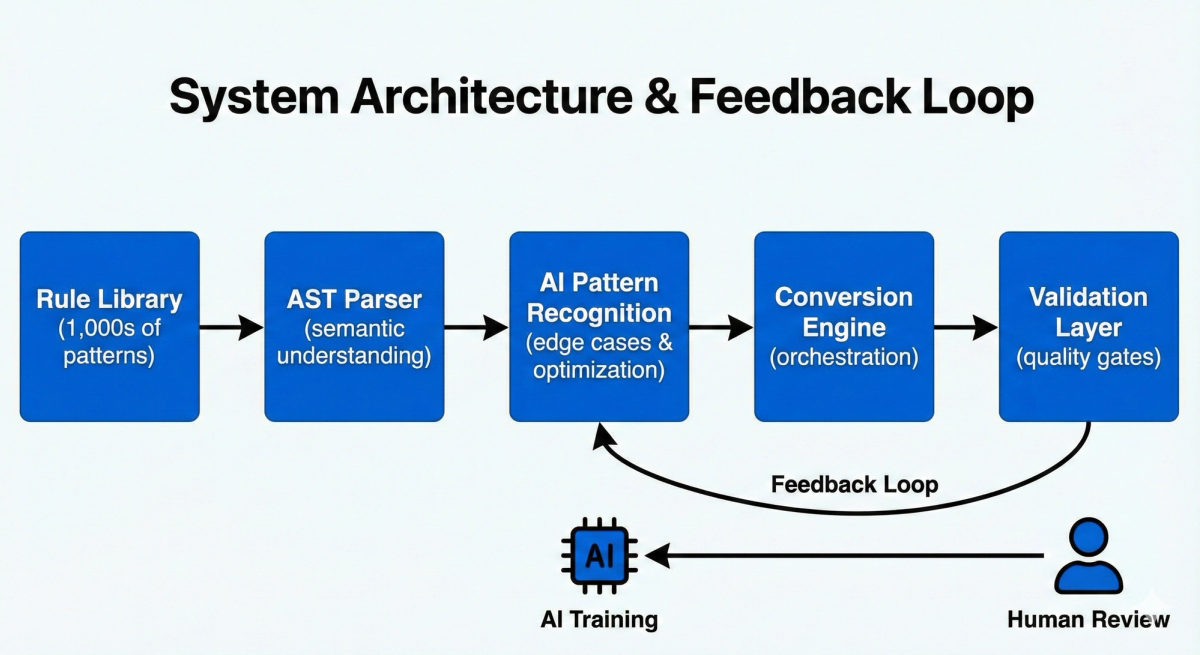
1. Rule-Anchored Transformation (Not Blind AI)
AI without guardrails is chaos, which is why we've seen so many AI-powered code conversion tools produce spectacular failures in production. Pure machine learning approaches to code conversion produce unpredictable results—sometimes brilliant, sometimes catastrophic, always opaque. You can't explain why the AI made the choices it did, which means you can't audit the transformation, validate that it's correct, or learn from errors to prevent them in the future.
SmartConvert uses a hybrid approach with 100s of pre-built conversion rules as its foundation. These rules encode:
- Dialect-specific patterns (how cursors work in T-SQL vs. PL/SQL vs. BigQuery)
- Platform capabilities (what window functions are available in each system)
- Proven migration practices (how to handle temp tables, how to rewrite dynamic SQL, how to preserve transaction semantics)
The rules have been gathered over years, that augment the AI producing almost deterministic results (same input always produces same output), t
AI augments these rules rather than replacing them:
- Pattern recognition for edge cases the explicit rules don't cover
- Optimization suggestions based on target platform capabilities
- Learning from human review to improve future conversions
The result: 95% automated conversion rate with full traceability from source to target.
2. Abstract Syntax Tree (AST) Parsing (Not String Manipulation)
Most conversion tools treat code as text—they use regular expressions, string replacement, and template matching. This works fine for trivial transformations like renaming functions or changing syntax for simple expressions, but it fails catastrophically when you encounter nested logic, dynamic SQL, complex dependencies, or any situation where the meaning of code depends on context rather than just syntax.
Consider a simple example: a WHERE clause that includes a subquery that itself contains a function call that references a temp table created in a previous statement. A string-based tool sees these as disconnected pieces of text. An AST-based tool understands the relationships—the temp table must be created before it's referenced, the function must exist before it's called, the subquery must return a compatible data type for the comparison operation.
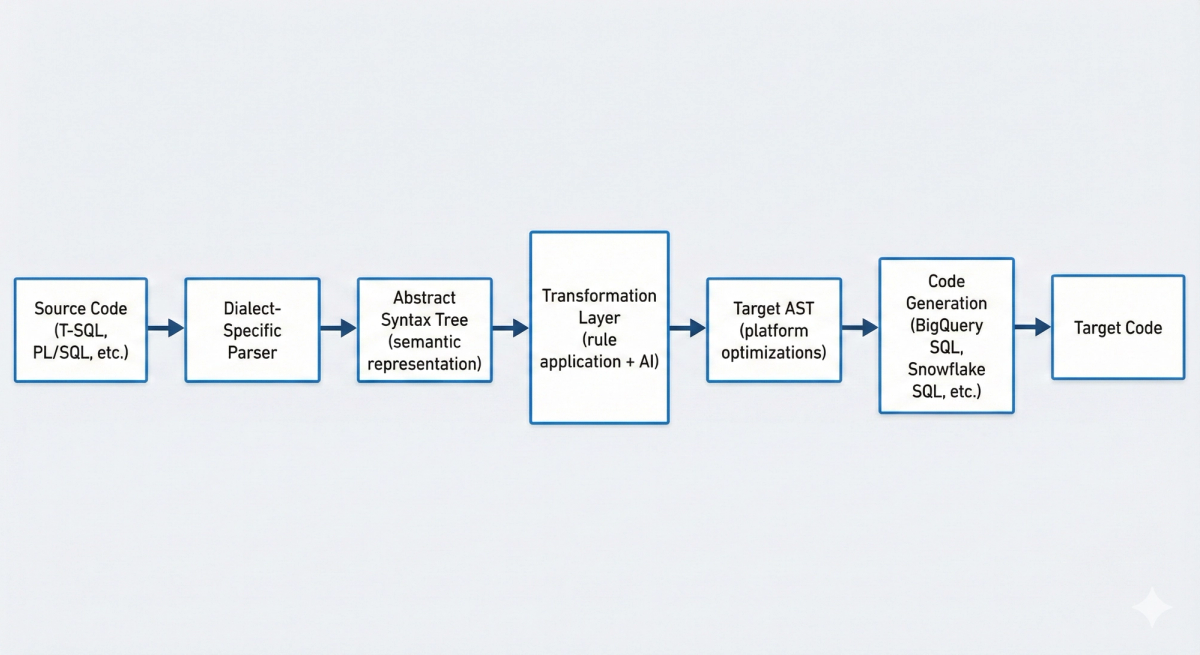
SmartConvert parses source code into Abstract Syntax Trees—structured representations that capture semantic meaning, not just syntactic form. This enables:
- Semantic preservation: Converting logic, not just syntax—understanding that T-SQL's CHARINDEX and BigQuery's STRPOS have equivalent semantics (both start at 1, both return 0 for not found)
- Dependency tracking: Building a graph of which procedures call which, which tables are referenced where, enabling correct migration ordering
- Context-aware transformation: Adapting conversions based on surrounding code—if a query includes a GROUP BY, window functions need special handling
- Validation: Comparing source and target ASTs for logical equivalence rather than just string matching
AST-driven conversion is why SmartConvert handles dynamic stored procedures (where SQL is constructed as strings at runtime), embedded SQL (where queries are interspersed with application logic), and multi-language notebooks (where Python, SQL, and shell commands all interact)—scenarios where text-based tools simply give up.
3. Continuous Validation (Not Post-Migration Testing)
Traditional approaches validate at the end: migrate everything, then test everything, then fix everything. This creates a validation crisis—thousands of failures discovered simultaneously with no systematic way to triage or remediate.
SmartConvert validates continuously, with quality gates that prevent objects from advancing until validation passes:
Validates that transformations preserve semantics and follow best practices:
- Syntax correctness: Generated code is valid in target dialect
- Semantic equivalence: AST comparison shows same logical operations
- Rule coverage: Every construct handled by at least one rule, no gaps
- Platform optimization: Target code uses idiomatic patterns, not mechanical translations
- Deployment success: CREATE statements executed without errors
- Schema validation: Tables have expected columns, types, constraints
- Object creation: Procedures are callable, views return expected columns
- Environment consistency: Dev/test/prod environments have matching schemas
Quality gates catch issues immediately when they're introduced rather than discovering problems at the end. This approach achieves 100% accuracy and 99% validation pass rates before production cutover.
The Governance Layer: Human-in-the-Loop by Design
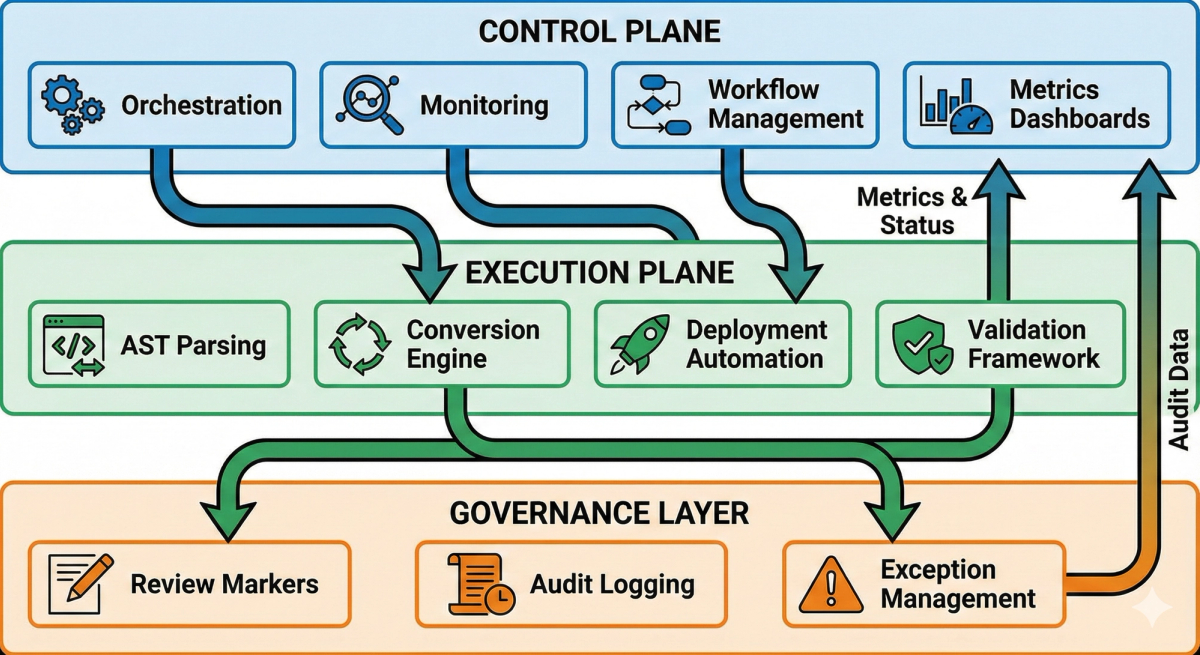
Automation without governance is just chaos at scale. SmartConvert embeds human oversight at critical decision points through a human layer that ensures experts remain in control while still benefiting from automation's speed and consistency.
Most objects flow through automatically. Review is focused on exceptions—high-complexity objects, unusual patterns, business-critical logic, optimization decisions with trade-offs.
Exception Management
When automated conversion can't handle an object or validation fails, SmartConvert provides structured information that makes resolution efficient:
- Specific object that failed (with full source code and attempted conversion)
- Specific issue that caused failure (syntax error, semantic ambiguity, missing feature)
- Recommended remediation (with examples from similar resolved cases)
- Relevant documentation (knowledge base articles and platform docs)
Reviewers make informed decisions with full context, document their rationale, and feed that knowledge back into the system so similar cases can be handled better in future migrations.
This governance model is what allows SmartConvert to achieve both velocity (95% automation, 80% faster delivery) and quality (100% data accuracy, 99% validation pass rate). Automation handles repetitive work, governance ensures expert oversight where it matters, and the combination produces better results than either pure automation or pure manual work could achieve.
Platform Support: Any-to-Any at Scale
SmartConvert's architecture is platform-agnostic. The same five-phase process works across:
Source Platforms
- Legacy on-premises: Oracle, SQL Server, Teradata, DB2, Netezza
- Legacy cloud: AWS Redshift (first-gen)
- Modern cloud: Snowflake, Databricks (cross-cloud)
- Open-source: PostgreSQL, MySQL
- Big data: Hive, Impala, Spark
Target Platforms (Primary Focus: Google Cloud)
- BigQuery: Serverless data warehouse, petabyte-scale, with SQL conversion, schema migration, performance optimization
- Cloud SQL: Managed PostgreSQL, MySQL, SQL Server with stored procedure conversion, high availability configuration
- Amazon Redshift: Cloud data warehouse with SQL conversion and performance tuning
- PostgreSQL, MySQL (Cloud-hosted): Managed instances on AWS RDS, Azure Database, or other cloud platforms
Why SmartConvert Now: The Modernization Imperative
Three forces are converging to make systematic migration not just advantageous but essential:
1. Legacy Platform End-of-Life
Oracle, Teradata, and other legacy vendors are aggressively pushing cloud migrations. Support windows are closing, license costs are escalating. Enterprises that delay face forced migrations on vendor timelines, not their own.
2. Cloud-First Mandates
Boards and CFOs are demanding cloud adoption targets. Every quarter that data warehouses remain on-premises is a quarter of lost agility, scalability, and cost efficiency. Migration speed is becoming a competitive advantage.
3. Talent Scarcity
The specialists who understand legacy platforms are retiring or moving to modern stacks. Finding experts who can manually convert 10,000 Oracle stored procedures is getting harder and more expensive. Automation is the only scalable path forward.
The window for orderly, systematic migration is closing. The alternative—reactive, chaotic migration driven by vendor ultimatums—is far more expensive and risky.
SmartMigrate Series:
- The Architecture of Certainty – How SmartMigrate Works End-to-End
- SmartExtract – Seeing Everything Before You Move
- SmartDiscover – Turning Complexity into Clarity
- SmartConvert – Precision at Scale (You are here)
- SmartReconcile Trust, Proven. Validation, parity, and quality assurance in modernization.
SmartMigrate: Modernize Your Data Infrastructure with Certainty