
Every data modernization program begins with the same uncomfortable question: "What are we actually dealing with?"
For most enterprises, the answer lives scattered across wiki pages, outdated ERDs, tribal knowledge, and that one DBA who's been there since 2003. The result? Analysis paralysis. Teams spend months inventorying, only to discover halfway through migration that critical dependencies were missed, complexity was underestimated, and timelines were fiction.
SmartDiscover exists to collapse weeks of guesswork into days of certainty.
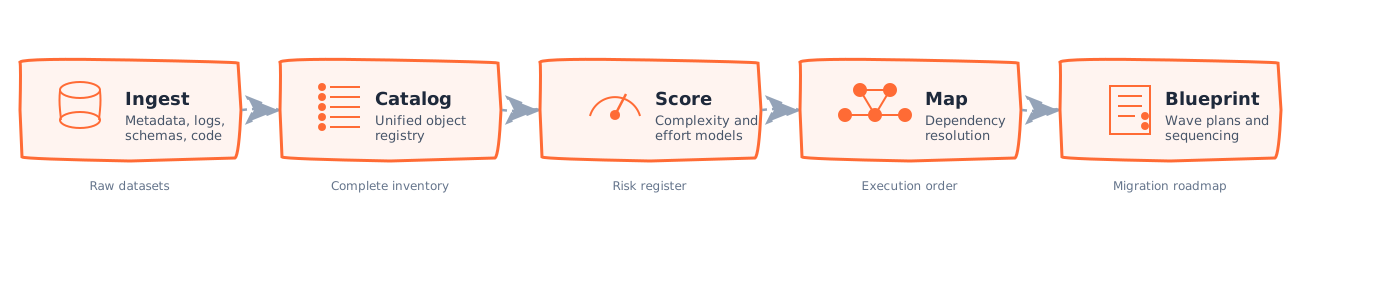
It transforms raw metadata, logs, and code exports into a sequenced, risk-aware migration blueprint—complete with complexity scores, dependency graphs, and wave-by-wave execution plans. This isn't a scanning tool. It's the difference between walking into migration blind versus walking in with a map, a plan, and confidence.
The Three Lenses: How SmartDiscover Sees Your Estate
1. Inventory & Cataloging
SmartDiscover ingests outputs from SmartExtract—schemas, stored procedures, ETL jobs, query logs, table statistics—and builds a unified catalog of everything that needs to move.
But it's not just counting objects. It's understanding what they do:
- Stored procedures: Control flow depth, transaction complexity, external dependencies
- Tables: Row counts, storage footprint, partition strategies, distribution keys
- ETL jobs: Transformation logic, schedule dependencies, data lineage
- Queries: Frequency, cost, performance characteristics
The outcome: A single-pane inventory that answers "How big is this problem?" with precision, not estimates.
2. Complexity Scoring & Effort Estimation
Not all migrations are created equal. A simple SELECT * FROM table is trivial. A 2,000-line stored procedure with dynamic SQL, temp tables, cursors, and nested transactions? That's a different story.
SmartDiscover applies proprietary scoring algorithms to assess migration difficulty per object. While we don't reveal the exact formula (that's our secret sauce), the model considers factors like:
- Control flow complexity (loops, conditionals, exception handling)
- Data lineage depth (how many upstream/downstream dependencies)
- Dialect-specific constructs (features that don't have direct equivalents in the target)
- Historical change frequency (how often has this been modified?)
Each object gets a complexity score (Low/Medium/High/Critical) and an estimated conversion effort. This isn't a magic eight-ball—it's calibrated against thousands of real migrations.
The outcome: You know exactly which 20% of your estate will consume 80% of effort. No surprises.
3. Dependency Mapping & Risk Analysis
Here's where things get interesting. Most assessment tools stop at inventory. SmartDiscover goes deeper: it maps the object graph—the web of dependencies that dictate migration order.
- Which stored procedures call which functions?
- Which ETL jobs depend on which tables?
- Which dashboards break if a view changes?
The platform builds a directed acyclic graph (DAG) that reveals:
- Critical paths: Objects that block others (migrate these first)
- Orphans: Objects with no dependencies (safe to defer or retire)
- Circular dependencies: Anti-patterns that need manual remediation
SmartDiscover also flags readiness risks:
- Deprecated syntax that has no target equivalent
- Anti-patterns (e.g.,
SELECT *in production queries) - Security issues (e.g., hard-coded credentials in scripts)
- Performance hotspots (e.g., Cartesian joins, missing indexes)
The outcome: A risk register that tells you what will break, what needs refactoring, and what's safe to automate.
From Assessment to Action: The Migration Blueprint
SmartDiscover doesn't just produce reports. It produces actionable migration blueprints:
Wave Planning
Objects are grouped into logical migration waves based on:
- Dependency constraints (you can't migrate Table B before Table A)
- Complexity balance (don't front-load all the hard stuff)
- Business priority (migrate revenue-critical workloads first)
- Risk tolerance (isolate high-risk conversions for controlled rollout)
Each wave includes:
- Object manifest: What's moving
- Acceptance criteria: How we define "done"
- Rollback plan: What happens if things go sideways
Conversion Readiness
For each object, SmartDiscover provides:
- Automated conversion confidence: Will SmartConvert handle this automatically?
- Manual intervention flags: Does this need expert review?
- Target pattern recommendations: Modern equivalents for legacy constructs
Export for SmartConvert
The blueprint exports as step-ready file collections that SmartConvert can ingest directly. No manual munging. No copy-paste. Just seamless handoff.
Real-World Impact: Two Scenarios
How cool would it be if you could see this in action? Take the following examples:
Scenario 1: Financial Services – Oracle to BigQuery
A global bank had 12,000+ Oracle stored procedures supporting core banking operations. Before SmartDiscover, their assessment estimate was "18–24 months, high risk."
SmartDiscover findings (2 weeks):
- 40% of procedures were low-complexity (CRUD operations)
- 15% were orphaned (no active callers—candidates for retirement)
- 8% contained critical business logic requiring human review
- Dependency graph revealed 200 "keystone" procedures blocking others
Outcome: Blueprint identified 3 waves over 12 months. 60% of estate could be automated. High-risk objects isolated for expert-led conversion. Migration confidence went from "uncertain" to "executable."
Scenario 2: Pension Services – DB2 to PostgreSQL
A pension service provider had 8,000 ETL jobs on DB2 with zero documentation. Previous assessment attempts stalled after 3 months.
SmartDiscover findings (10 days):
- 5,200 jobs were simple extracts (no transformation logic)
- 1,800 jobs shared common patterns (template-based conversion)
- 400 jobs had complex stored procedures requiring dialect mapping
- 600 jobs were inactive (not run in 6+ months)
Outcome: Blueprint prioritized active, high-impact jobs. Complexity-weighted waves ensured critical paths moved first. Timeline compressed from "unknown" to "8 weeks for priority workloads."
Why This Matters: Certainty as Strategy
Most migration programs fail not because of technology—they fail because of underestimated complexity and invisible dependencies. Teams commit to timelines based on guesses, then spend months firefighting when reality hits.
SmartDiscover flips the script:
- See the whole problem before you commit to a solution
- Quantify effort so stakeholders trust the plan
- Sequence intelligently so early wins build momentum
- Flag risks early so remediation happens on your terms, not in production
When you walk into a steering committee meeting with a dependency graph, a risk register, and a wave-by-wave roadmap, you're not pitching a migration. You're presenting a de-risked transformation strategy.
The Path from Chaos to Clarity
Migration doesn't have to feel like archaeology. With SmartDiscover, it feels like engineering.
You stop guessing. You stop estimating. You start knowing.
And when SmartConvert picks up where SmartDiscover leaves off, you're not converting code—you're executing a plan that was designed for certainty from day one.
This is how modern enterprises migrate: with clarity, with confidence, with SmartDiscover.
SmartMigrate Series:
- The Architecture of Certainty – How SmartMigrate Works End-to-End
- SmartExtract – Seeing Everything Before You Move
- SmartDiscover – Turning Complexity into Clarity (You are here)
- Next: SmartConvert – Precision at Scale
SmartMigrate: Modernize Your Data Infrastructure with Certainty