
The Invisible Tax of Legacy Systems
Every enterprise data warehouse hides a secret: no one truly knows what's inside anymore.
After decades of organic growth, what started as a structured data platform has evolved into a labyrinth. Business logic lives in stored procedures written by engineers who retired five years ago. Critical ETL jobs reference tables that may or may not still exist. Query patterns optimized for workloads from 2015 still run nightly, consuming resources no one dares to touch.
The result? When modernization conversations begin, they start with guesswork. Teams estimate object counts, complexity, and dependencies based on institutional memory and outdated documentation. Budgets balloon. Timelines stretch. Risk compounds.
Migration projects fail not because the destination is unclear, but because the origin is invisible.
You Can't Migrate What You Can't See
Traditional discovery processes are manual, incomplete, and fragile:
- Spreadsheet archeology – Manual cataloging of objects across siloed systems
- Tribal knowledge – Dependency mapping based on developer interviews and assumptions
- Point-in-time snapshots – Exports that become stale before planning even begins
- Incomplete coverage – Critical metadata scattered across system tables, log files, and runbooks
The cost of this opacity is staggering. Teams over-provision conversion efforts "to be safe." They miss dependencies until production breaks. They convert unused objects alongside critical ones, wasting weeks on technical debt that should have been retired.
SmartExtract solves this. It makes the invisible visible—safely, verifiably, and at program scale.
What SmartExtract Does
SmartExtract is an expert-operated extraction accelerator that safely pulls metadata, logs, and optional data samples from legacy data warehouses into cloud storage—producing standardized, audit-ready outputs for assessment and conversion.
Core Capabilities
1. Comprehensive Metadata Extraction
- Schema definitions (DDL for tables, views, indexes, constraints)
- Code objects (stored procedures, functions, triggers)
- Statistics and distribution hints (row counts, storage sizes, partitioning schemes)
- Query logs for performance baselining and workload rationalization
2. High-Throughput, Resumable Exports
- Parallel extraction workers for multi-terabyte estates
- Chunking and checkpointing for resilience
- Automatic retry on transient failures
- Rate limiting to avoid production impact
3. Standardized, Verifiable Outputs
- Manifests with checksums for every artifact
- Compressed bundles organized by domain and object type
- Ready-to-ingest formats for SmartDiscover and SmartConvert
- Audit trails for compliance and traceability
4. Security-First Design
- Operates entirely inside your environment
- Read-only access to source systems
- Metadata-only mode by default
- Optional data sampling with policy-driven masking
- Encrypted in transit and at rest
Why Visibility Is a Strategic Advantage
SmartExtract doesn't just accelerate discovery—it transforms how you approach modernization.
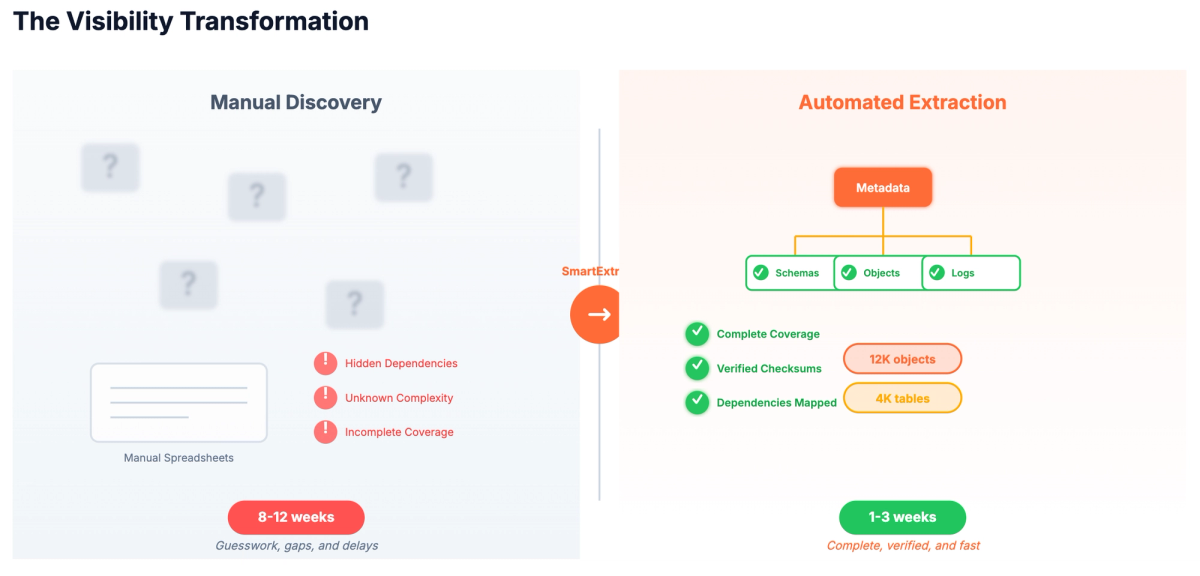
- Foggy/unclear system diagram with question marks
- Manual spreadsheets with gaps
- Red warning icons (hidden dependencies, unknown complexity)
- Timeline: 8-12 weeks of manual discovery
Right Side - "With SmartExtract": - Clear, structured metadata tree
- Complete coverage indicators (checkmarks)
- Green validation icons (verified checksums, complete manifests)
- Timeline: 1-3 weeks automated extraction
Purpose: Dramatic visual contrast showing transformation from uncertainty to clarity
1. Know Before You Go
With complete, verified metadata in hand, you can:
- Size the migration accurately – No more guessing at object counts or complexity
- Identify quick wins – Spot unused objects, redundant logic, and retirement candidates
- Sequence intelligently – Map dependencies to avoid mid-flight surprises
- Right-size budgets – Replace estimates with evidence-based planning
2. De-Risk from Day One
Visibility = predictability. When you see the entire landscape:
- Dependencies become explicit – No hidden cross-references breaking production
- Complexity is scored objectively – Flag high-risk objects for expert review
- Workload patterns inform testing – Use query logs to validate performance post-migration
3. Unlock Continuous Modernization
SmartExtract isn't a one-time activity. Its outputs become the system of record for your data estate:
- Refresh metadata periodically to track drift and changes
- Feed downstream tools (lineage engines, governance platforms)
- Enable iterative migration waves with updated context
How It Works: Extraction in Three Steps
Step 1: Connect
- Grant read-only access to source system catalogs and logs
- Deploy extraction workers inside your environment (on-prem or VPC)
- Configure object storage for outputs (GCS, S3, Azure Blob)
Step 2: Extract
- Run parallel jobs to pull metadata, statistics, and logs
- Monitor progress via live dashboards
- Resume on failure; retry transient errors automatically
Step 3: Verify & Deliver
- Validate checksums and completeness
- Generate manifests with lineage metadata
- Hand off standardized bundles to SmartDiscover for assessment
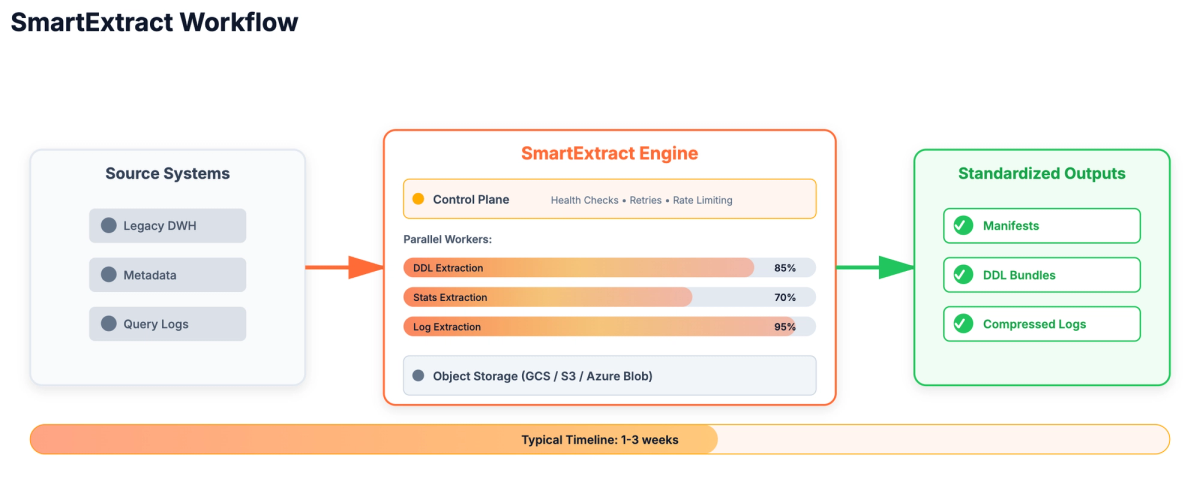
- Source Systems (legacy warehouse icons) →
- SmartExtract Engine (with parallel worker threads, control plane, storage sink) →
- Standardized Outputs (manifests, DDL bundles, logs in cloud storage)
Visual Style: Use SmartMigrate brand colors (primary orange for active extraction, amber for workers, gray for infrastructure)
Purpose: Make the technical architecture tangible and show the transformation from raw systems to structured metadata
Timeline: 1–3 weeks for most enterprise estates (depending on source scale and complexity)
Platform Coverage — Built for Heterogeneous Reality
SmartExtract meets enterprises where they are. It supports legacy, open-source, and cloud platforms alike—because modernization rarely happens in one place.
Supported platforms and sources:
- Enterprise Warehouses: Teradata, DB2, Netezza, Oracle (PL/SQL), SQL Server (T-SQL)
- Open-Source & Cloud: PostgreSQL, MySQL, Hive, Impala, Redshift, Spark
- Modern Cloud: BigQuery, Snowflake, Databricks, Azure Synapse, Cloud SQL
- ETL & Workflow: Informatica, Talend, DataStage, Airflow, NiFi, SSIS
- Analytics & BI: Looker, Power BI, Tableau (SQL lineage extraction)
- Application Code: Java (via SJMF), Python notebooks, shell scripts
SmartExtract is extensible by design. With each engagement, new connectors are added to meet program-specific needs—because visibility has to be comprehensive to be useful.
SmartExtract in Action: A Real Example
Challenge: A global financial services firm needed to migrate 12,000 Oracle stored procedures to BigQuery. Their internal team had spent 8 weeks manually cataloging objects—and still had incomplete coverage.
Solution: SmartExtract extracted the entire Oracle estate in 5 days:
- 12,347 stored procedures (with full DDL and dependencies)
- 4,200 tables (with schema, statistics, and partitioning metadata)
- 18 months of query logs (1.2 TB compressed)
- 100% verification via checksums and manifests
Outcome:
- SmartDiscover ingested the outputs immediately, producing a migration blueprint in week 2
- Dependency mapping revealed 400+ unused procedures, reducing conversion scope by 15%
- Cost savings: £180K (avoided manual cataloging effort)
- Objects Extracted: 12,347 stored procedures (with icon)
- Tables Cataloged: 4,200 tables (with schema icon)
- Query Logs: 18 months / 1.2TB (with log/time icon)
- Time Saved: 5 days vs. 8+ weeks manual (with clock/savings icon)
Visual Style: Use primary orange for metrics, clean card design with large numbers
Purpose: Make the scale and speed of extraction tangible and impressive
The Foundation of Certainty
Modernization isn't about taking a leap of faith. It's about building a foundation of evidence, clarity, and control—so that every decision downstream is grounded in reality, not assumptions.
SmartExtract delivers that foundation. It makes the invisible visible. It turns guesswork into certainty. And it ensures that when you move, you move with confidence.
Because you can't modernize what you can't see. But with SmartExtract, you see everything.
What's Next?
Now that you have complete visibility into your legacy estate, the next step is turning that data into actionable intelligence.
Coming Next: SmartDiscover – Turning Complexity into Clarity
Learn how SmartMigrate transforms raw metadata into complexity scores, dependency maps, and migration-ready blueprints.
SmartMigrate Series:
- The Architecture of Certainty – How SmartMigrate Works End-to-End
- SmartExtract – Seeing Everything Before You Move (You are here)
- SmartDiscover – Turning Complexity into Clarity (Coming next)
SmartMigrate: Modernize Your Data Infrastructure with Certainty